
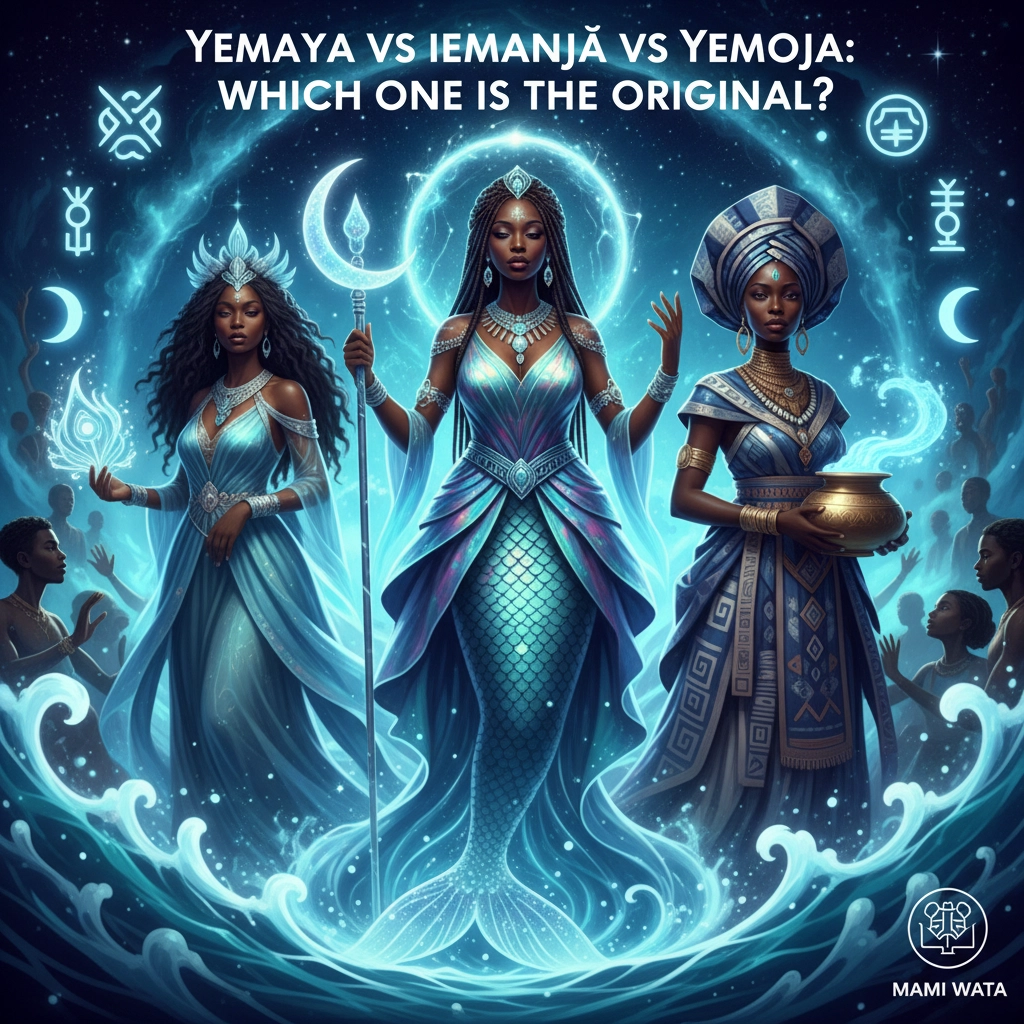
You've seen her name spelled three different ways, and maybe you're wondering, which one is "right"? Are we talking about three different goddesses, or is there something deeper going on here? Let me clear this up for you right now: Yemoja is the original.
All three names, Yemoja, Yemaya, and Iemanjá, refer to the same powerful Yoruba Orisa, the mother of waters. But their different spellings tell an incredible story of survival, adaptation, and the unbreakable bonds between people and their spiritual traditions. Ready to dive deep into the waters of history with me?
The Original: Yemoja of Yorubaland
Let's start where it all began, in Yorubaland, West Africa. The name Yemoja comes straight from the Yoruba language, and when you break it down, the meaning will give you chills. Yeye (mother) + omo (children) + eja (fish) = "Mother whose children are the fish."
Are you getting the power of that? This isn't just some poetic description. In Yoruba cosmology, Yemoja is literally the mother of all life that flows from water. She's the Orisa of the Ogun River, the largest river system in Yorubaland, and by extension, she governs all waters, rivers, springs, and yes, eventually the ocean itself.
But here's what most people don't understand: Yemoja wasn't originally an ocean goddess. That transformation happened later, and it's one of the most beautiful examples of how spiritual traditions adapt to survive.

The Diaspora: When Waters Crossed Oceans
When enslaved Africans were brutally torn from their homeland and shipped across the Atlantic, they didn't just bring their bodies, they carried their gods in their hearts. But here's the thing about spiritual survival: it requires adaptation.
Think about it. You're taken from the banks of the Ogun River and suddenly you're staring at an endless ocean. What do you do? You recognize your mother in these new waters. Yemoja, who had always been about the life-giving properties of fresh water, expanded her domain to embrace the salt waters that now surrounded her children.
This is where the linguistic shifts begin, and honestly, they're more beautiful than tragic when you understand what was really happening.
Yemaya: The Cuban Evolution
In Cuba, enslaved Yoruba people (called Lucumi) maintained their traditions through what we now know as Santería. Yemaya emerged as the Spanish-influenced pronunciation of Yemoja's name. But don't think this was just about language, the Cuban Yemaya took on characteristics that reflected her people's new reality.
Suddenly, she became the queen of the ocean, the mother of all Orisas born from the primordial waters. Her colors shifted to blue and white, reflecting the Caribbean seas. Her children learned to honor her at the ocean's edge, not the river's bank.
Iemanjá: Brazil's Beloved Sea Mother
In Brazil, Portuguese colonial influence shaped how Yemoja's name evolved into Iemanjá (also spelled Yemanjá). Within Candomblé traditions, she became deeply woven into Brazilian culture in ways that would make your heart sing.
Every New Year's Eve, millions of Brazilians, practitioners and non-practitioners alike, head to the beaches to honor Iemanjá. They bring white flowers, perfume, mirrors, and heartfelt requests. The sight of Copacabana beach covered in white offerings is enough to bring tears to your eyes.

Same Goddess, Different Waters
Here's what you need to understand: despite the different names and regional variations, we're talking about the same divine feminine energy. The core essence remains unchanged, she's the great mother, the protector of children, the healer, the one who holds the mysteries of feminine power.
But let's get real about the differences, because they matter:
Traditional Yemoja (Yorubaland):
- Governs fresh water, rivers, and springs
- Associated with fertility and motherhood
- Colors include blue, white, and sometimes silver
- Offerings include fish, watermelon, molasses
Yemaya (Cuba/Santería):
- Rules the ocean and all salt waters
- Mother of many Orisas in the pantheon
- Colors are blue and white (sometimes with silver accents)
- Offerings include watermelon, molasses, white flowers, perfume
Iemanjá (Brazil/Candomblé):
- Queen of the sea and protector of fishermen
- Deeply connected to Brazilian national identity
- Colors are blue and white
- Offerings include white flowers, perfume, jewelry, mirrors

The Power of Names and Why It Matters
You might be thinking, "Okay, but why does the name matter if it's the same goddess?" Great question. Names carry power, history, and cultural identity. When you say "Yemoja," you're connecting directly to her African roots. When you say "Yemaya" or "Iemanjá," you're acknowledging the incredible journey of survival and transformation that happened in the Americas.
Each name tells a story of resilience. Each pronunciation carries the breath of people who refused to let their spiritual traditions die, even under the most horrific circumstances.
Are you someone who's been confused about which name to use? Here's my advice: honor the tradition you're working within. If you're studying traditional Yoruba religion, use Yemoja. If you're working within Santería, Yemaya is appropriate. In Candomblé contexts, Iemanjá is the name that carries the proper cultural weight.
Modern Recognition and Global Worship
Here's something beautiful happening right now: as people worldwide become more interested in African spiritual traditions, there's growing recognition of these connections. Spiritual practitioners are learning to trace these lineages back to their source while respecting the valid adaptations that happened in the diaspora.
You'll find people who work with all three aspects: honoring Yemoja as the original river mother, Yemaya as the ocean queen, and Iemanjá as the beloved Brazilian sea goddess. This isn't confusion; it's sophisticated spiritual understanding.

What This Means for Your Practice
If you're drawn to work with this powerful Orisa, start by understanding her journey. Don't just pick a name because it sounds pretty: connect with the cultural and historical context that created each variation.
Ask yourself: What waters call to you? The life-giving rivers of Africa? The powerful oceans of the Caribbean? The celebratory beaches of Brazil? Your answer might guide you toward the aspect that resonates most deeply with your spiritual path.
But remember: whatever name you use, approach with respect. These aren't just different spellings; they represent real traditions with living communities. If you're serious about this work, take time to learn properly, find legitimate teachers, and understand the cultural protocols.
The Unifying Truth
At the end of the day, whether you call her Yemoja, Yemaya, or Iemanjá, you're reaching toward the same divine feminine energy that has sustained millions of people across centuries and continents. She is the original mother, the one whose waters of life flow through every variation of her name.
The next time someone asks you about the "difference" between these goddesses, you can share the real story: not of three separate deities, but of one magnificent Orisa whose love was so powerful it survived slavery, crossed oceans, and adapted to new shores while never losing its essential truth.
Yemoja is the original, but Yemaya and Iemanjá are her legitimate daughters, born from the marriage of tradition and survival. All three deserve our respect, understanding, and devotion.
Ready to honor the mother of waters in whatever form calls to your spirit?
