
Look, let's be real about something that's been keeping me up at night lately. Are you watching your elders pass away while their spiritual knowledge goes with them? Because that's exactly what's happening in African spiritual communities worldwide, and it's heartbreaking.
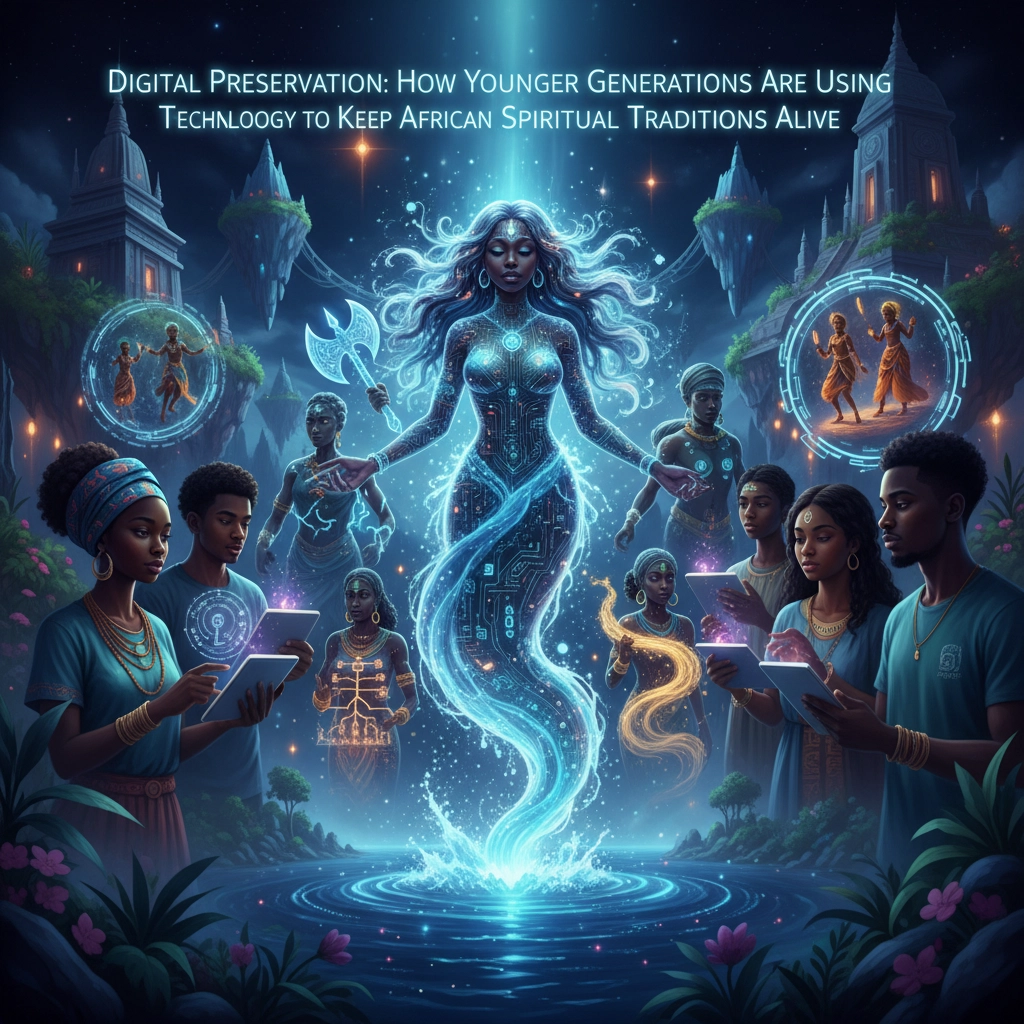
But here's the thing: the younger generation isn't just sitting around watching our traditions disappear. They're getting creative, and honestly? They're doing things our ancestors never could have imagined. These young folks are using technology to preserve Vodun ceremonies, document Orisa traditions, record Mami Wata rituals, and keep Edo spiritual practices alive in ways that are absolutely revolutionary.
Your Smartphone Is Now a Sacred Archive
You know that device you're probably reading this on right now? It's become the most powerful tool for preserving African spiritual traditions in human history. Young practitioners are using AI-powered transcription apps to convert their grandmothers' spoken memories about Osun ceremonies into permanent digital records.
Picture this: A 22-year-old in Brooklyn sits with her Yoruba grandmother, recording stories about how to properly approach Sango during thunder season. That conversation, which might have been lost forever, now lives in a searchable digital archive that can be passed down for generations.

The beauty of this approach is that it captures not just the words, but the emotion, the inflection, the pauses that carry meaning in oral traditions. When an elder describes the proper way to prepare for a Mami Wata ceremony, those subtle vocal cues about respect and reverence get preserved too.
Social Media: The New Village Square for Spiritual Learning
Stop for a moment and think about this: TikTok videos about Vodun practices are getting millions of views. Instagram accounts dedicated to authentic Orisa worship are building communities of thousands. YouTube channels teaching traditional Edo spiritual songs are connecting diaspora communities across continents.
Is this perfect? Hell no. Are some people appropriating and misrepresenting our traditions? Absolutely. But the flip side is remarkable: young people who were disconnected from their spiritual roots are finding their way back through digital communities.
I've seen teenagers in London learning authentic Esu prayers through WhatsApp groups with elders in Lagos. Kids in Atlanta are participating in virtual Ifa study sessions with babalawo in Benin City. The technology is literally rebuilding the village connections that colonization and migration broke apart.
The Archive Revolution: More Than Just Recording
Here's where things get really exciting. Young preservationists aren't just recording random spiritual content: they're building comprehensive digital archives using professional-grade methodology. We're talking metadata, provenance tracking, and preservation standards that would make librarians weep with joy.

These archives are capturing:
- High-resolution videos of complete Vodun ceremonies
- Audio recordings of traditional Orisa oriki (praise songs)
- Digital scans of handwritten spiritual texts
- 3D models of sacred objects and shrine setups
- Geographic data about sacred sites and their histories
The Akatakpa Rebirth Project, for example, is using artificial intelligence to preserve Igbo ancestral veneration practices. They're not just recording the rituals: they're documenting the philosophical foundations, the seasonal timing, the community roles, everything that makes these traditions complete living systems rather than museum pieces.
Bridging the Digital Divide: When Grandparents Meet Smartphones
Now, let's talk about the elephant in the room. Many of our elders who hold this precious knowledge aren't exactly tech-savvy. The digital divide between generations is real, and it's threatening the survival of practices that have sustained our communities for thousands of years.
But here's what's beautiful: young people are creating solutions. They're developing user-friendly recording setups, teaching elders basic digital skills, and most importantly, they're showing up consistently to capture this knowledge before it's gone.
Are you one of those people who keeps saying you need to "sit down with grandma" and record her stories? Stop procrastinating. Download a transcription app, charge your phone, and go have that conversation today. Your future children will thank you.
Virtual Reality and the Sacred Experience
This is where things get wild. Young technologists are creating virtual reality experiences that let people participate in traditional ceremonies from anywhere in the world. Imagine being able to virtually visit a authentic Osun shrine in Nigeria while sitting in your apartment in Toronto.

These aren't video games or entertainment: they're serious educational and spiritual tools designed with input from traditional practitioners. They're helping diaspora communities maintain connections to sacred sites they might never be able to visit physically.
Community-Powered Preservation Projects
The most exciting development is how communities are organizing their own preservation efforts. Young people are creating crowdsourced databases where anyone can contribute family recipes for spiritual baths, upload photos of traditional shrine setups, or share audio recordings of ancestral songs.
These platforms operate on principles of community ownership and ethical sharing. They're not exploiting spiritual knowledge for profit: they're ensuring it survives for future practitioners while respecting the intellectual property and sacred nature of the content.
Want to get involved? Start documenting your own spiritual practices and family traditions. Even if you think you're "not traditional enough" or "don't know much," your piece of the puzzle matters.
Language Preservation in Spiritual Context
Here's something that keeps me up at night: we're losing the languages that carry spiritual power. The specific words used in Vodun ceremonies, the ancient Yoruba phrases for communicating with Orisa, the traditional Edo incantations: these aren't just words, they're keys to spiritual realms.
Young linguists and spiritual practitioners are working together to create comprehensive digital dictionaries that preserve not just translations, but pronunciation guides, contextual usage, and spiritual significance. They're ensuring that future generations won't lose the linguistic tools needed for authentic practice.

The Ethics of Digital Spirituality
Let me be straight with you about something important: not everything should be digitized and shared publicly. Some knowledge is meant to be transmitted only through proper initiation channels. Some rituals require specific community contexts. Some practices need the physical presence of elders and the energy of sacred spaces.
The young people leading these preservation efforts understand this. They're working closely with traditional authorities to establish guidelines about what can be shared openly versus what needs protection. They're creating private archives for initiated communities and public resources for general education.
This isn't about putting everything on the internet for anyone to access. It's about ensuring that authentic practitioners have the resources they need to maintain and transmit traditions properly.
Building Tomorrow's Spiritual Communities
What excites me most about this digital preservation movement is how it's creating new possibilities for spiritual community. Young people scattered across different continents can now study together, support each other's spiritual development, and maintain connections to traditional knowledge sources.

They're building apps that help practitioners track spiritual observations, platforms for finding authentic traditional teachers, and databases for researching the historical contexts of spiritual practices. Technology is becoming a tool for deeper spiritual engagement, not a distraction from it.
Your Role in This Revolution
So where do you fit in all this? Whether you're 15 or 65, whether you're just beginning your spiritual journey or you've been practicing for decades, you have a role to play in preserving these traditions.
Start by documenting your own spiritual practices and family stories. Use your smartphone to record conversations with elders. Join online communities dedicated to authentic traditional practices. Support young people who are building preservation platforms and resources.
Most importantly, remember that technology is just a tool. The real preservation work happens when we commit to living these traditions, practicing them authentically, and passing them on with the same reverence and integrity our ancestors showed.
The spirits aren't threatened by smartphones and digital archives: they're tired of watching their wisdom disappear. Your ancestors want their knowledge preserved and transmitted. Technology is just giving us new ways to honor that desire.
Ready to be part of this preservation revolution? The ancestors are waiting, and your smartphone is charged. What are you going to record first?
