
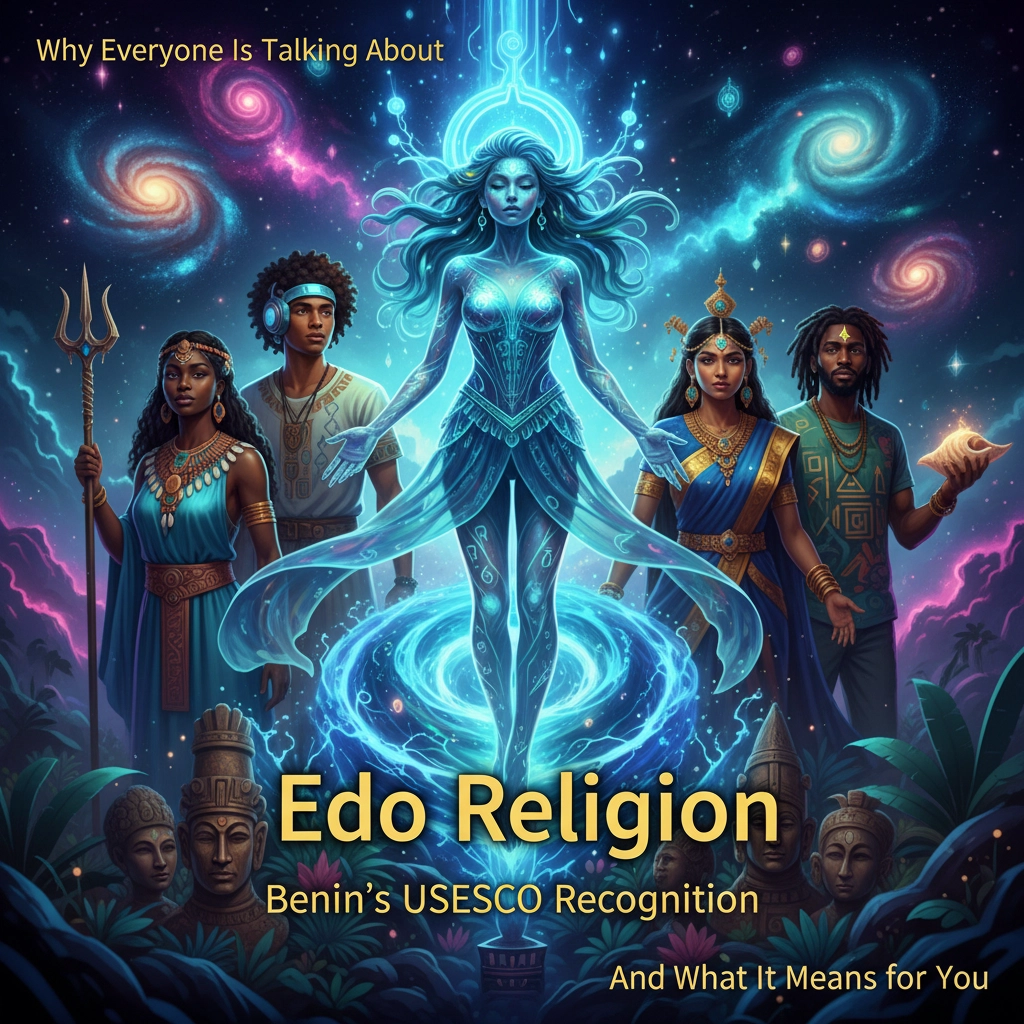
Are you feeling the shift happening in spiritual circles lately? There's something powerful stirring in conversations about African traditional religions, and Edo religion is at the center of it all. If you've been wondering why everyone from cultural scholars to spiritual practitioners is suddenly talking about the ancient traditions of the Edo people, you're about to understand exactly what's going on, and why it matters for your own spiritual journey.
Let's get one thing straight first: when we talk about Edo religion and its connection to UNESCO recognition, we're diving into a story that spans continents and centuries. The Edo people, who built the legendary Benin Kingdom in what's now Nigeria, created one of Africa's most sophisticated spiritual systems. And recent international recognition is finally giving this tradition the respect it deserves.
What Exactly Is Edo Religion?
Stop overthinking this, Edo religion, originally called Osagbaye, operates on a beautifully simple principle: "God is present in all its creativity." But don't let that simplicity fool you. This isn't some watered-down spiritual concept designed for mass consumption. We're talking about a complete cosmological system that has been guiding people for over a thousand years.

Think of Edo religion as existing in two interconnected worlds. There's the visible world where you're reading this right now, your daily struggles, your relationships, your job stress. Then there's the invisible world populated by gods, ancestors, and spiritual forces who are actively involved in your life whether you acknowledge them or not.
At the heart of this system sits the Oba, the king of the Benin Kingdom. But here's where it gets interesting: the Oba isn't just some ceremonial figurehead. In Edo cosmology, he's the "king of dry land," serving as the earthly counterpart to Olokun, the great water deity who controls wealth and fertility. When people say "as above, so below," the Edo people have been living this principle for centuries.
Your ancestors aren't just memories in family photos, they're active participants in your daily life. In Edo tradition, male family heads who lived full lives and had children become ancestral spirits who continue guiding their descendants. They have altars, they receive offerings, and yes, they absolutely have opinions about your life choices.
The UNESCO Connection That's Changing Everything
Here's where things get really exciting for anyone interested in cultural preservation and spiritual authenticity. The Republic of Benin currently has three UNESCO World Heritage Sites, including the Royal Palaces of Abomey and the W-Arly-Pendjari Complex. But the real game-changer? The growing recognition of traditional authorities like the Oba of Benin in cultural property protection.
Are you tired of seeing African artifacts sitting in European museums while their communities struggle to maintain their cultural practices? Well, so is everyone else. Nigeria's recent decision to resolve ownership of returning Benin Bronzes in favor of the Oba demonstrates something revolutionary: traditional institutions aren't just museum pieces: they're essential for effective cultural heritage protection.

This isn't just about pretty bronze sculptures gathering dust. When UNESCO and other international bodies recognize traditional authorities, they're acknowledging that indigenous governance systems offer valuable resources for global preservation efforts. The Oba of Benin isn't just a king: he's a cultural custodian whose authority spans both the spiritual and temporal realms.
Why This Ancient Religion Refuses to Die
Let me tell you something that might surprise you: when Portuguese missionaries showed up in the 15th century trying to convert the Benin Empire to Christianity, Edo religion didn't roll over and disappear. Instead, it did something brilliant: it adapted while maintaining its core essence.
Today in Edo state, Christianity, Islam, and traditional religion coexist peacefully. You'll find Benin monarchs, chiefs, and traditional title holders who dress like Catholic priests not because they've abandoned their traditions, but because they've incorporated symbols of royalty and cultural identity into their practice. This is what spiritual resilience looks like.
Stop believing that ancient traditions can't handle modern challenges. Edo religion has been proving skeptics wrong for centuries, surviving colonialism, missionary pressure, and modernization while maintaining its fundamental principles. The region has avoided the ethnic and religious conflicts that plague other areas precisely because these traditions teach coexistence and mutual respect.
What This Means for Your Spiritual Journey
Ready for some real talk? The growing attention on Edo religion reflects something bigger happening in spiritual communities worldwide. People are tired of disconnected, commercialized spirituality. They want traditions with roots, practices with purpose, and communities with authentic cultural foundations.

If you've been feeling called to explore African traditional religions, the international recognition of Edo practices represents a doorway opening. This isn't about cultural appropriation: it's about understanding how indigenous knowledge systems maintain relevance in contemporary contexts.
Are you wondering how ancient practices could possibly address modern problems? Consider this: Edo religion's emphasis on ancestral wisdom means you're not navigating life's challenges alone. Your ancestors' experiences, their struggles and triumphs, become resources for your current situation. When you honor them properly, they become advocates for your success.
The religion's recognition of both visible and invisible worlds means you get practical guidance for daily life alongside spiritual support for your deeper questions. Need career advice? There's a traditional consultation method for that. Dealing with family drama? The ancestors have been handling family conflicts for generations and have solutions.
The Decolonization of Spirituality
Let's address the elephant in the room: the renewed focus on Edo religion is part of a larger movement toward decolonizing spirituality. For too long, African traditional religions have been dismissed, demonized, or appropriated. The UNESCO recognition and return of cultural artifacts represent a global shift toward respecting indigenous knowledge systems.
You don't have to be Edo to appreciate what this means for spiritual freedom worldwide. When international bodies acknowledge the value of traditional cultural practices, they're creating space for all indigenous traditions to reclaim their rightful place in global conversations about spirituality, healing, and community building.

This recognition has practical implications beyond feel-good multiculturalism. As cultural property returns to its places of origin, as traditional authorities gain international recognition, as ancient practices receive academic study and respect: the entire landscape of spiritual options expands for seekers everywhere.
Your Next Steps in Understanding
Stop waiting for someone else to validate your spiritual curiosity. The growing conversation around Edo religion and its UNESCO connections represents an invitation to explore traditions that have sustained communities for millennia.
Whether you're drawn to the ancestral reverence, the sophisticated cosmology, or the practical wisdom embedded in these traditions, the current moment offers unprecedented access to authentic information and respectful engagement opportunities.
The Edo people's success in maintaining their traditions while adapting to changing circumstances offers a model for spiritual resilience that extends far beyond any single religion. Their emphasis on community, respect for natural forces, and integration of spiritual and temporal authority provides frameworks relevant to anyone seeking deeper meaning and stronger community connections.
Are you ready to move beyond surface-level spiritual exploration? The recognition of Edo religion's cultural significance represents more than academic interest: it's an acknowledgment that ancient wisdom traditions offer essential resources for navigating contemporary challenges.
The ancestors are speaking, UNESCO is listening, and the world is finally ready to hear what Edo religion has been teaching all along: that true spiritual power comes from honoring both the seen and unseen worlds while maintaining authentic community connections that span generations.
Your spiritual journey deserves traditions with depth, practices with power, and communities with genuine cultural foundations. The conversation around Edo religion isn't just academic: it's an invitation to explore what authentic spiritual practice looks like in the modern world.
