

Ever heard whispers about the serpent spirits of Dahomey and wondered if you're getting the full picture? You're not alone. The names Mami Lissa and Segbo Lissa often get tangled up in spiritual conversations, leaving many confused about who's who and what they actually do. But here's the thing, these aren't just two random snake spirits we're talking about. They're cosmic partners in the grand design of Benin Vodun tradition, each ruling their own domain while maintaining a divine dance that keeps the universe balanced.
Ready to untangle this serpentine mystery? Let's dive deep into the waters and soar through the skies to understand these powerful forces.
The Divine Duality: Two Serpents, Two Realms
Before we get into the nitty-gritty, let's clear something up right away. Mami Lissa and Segbo Lissa aren't the same being with different names, they're complementary forces representing different aspects of creation itself. Think of them as cosmic dance partners, each with their own spotlight moments while never losing sight of their shared rhythm.
Mami Lissa embodies the feminine principle of water, earth, and the flowing life force that nurtures all existence. She's the river goddess, the serpent mermaid who commands the depths and ensures fertility flows through the land. Segbo Lissa, on the other hand, represents the masculine principle of sky, creation, and the celestial order that governs from above. He's the sky serpent, the divine architect whose cosmic breath brings forth the very framework of reality.

Are you starting to see how these two work together? While Mami Lissa flows through the rivers and springs of life, Segbo Lissa stretches across the heavens, ensuring the cosmic order that makes her nurturing possible.
Mami Lissa: The Aquatic Empress
Let's start with Mami Lissa, because honestly, her story will take your breath away. In traditional Dahomean cosmology, she's not just another water spirit, she's THE water spirit, the one who controls the rivers, springs, and all the flowing waters that make life possible.
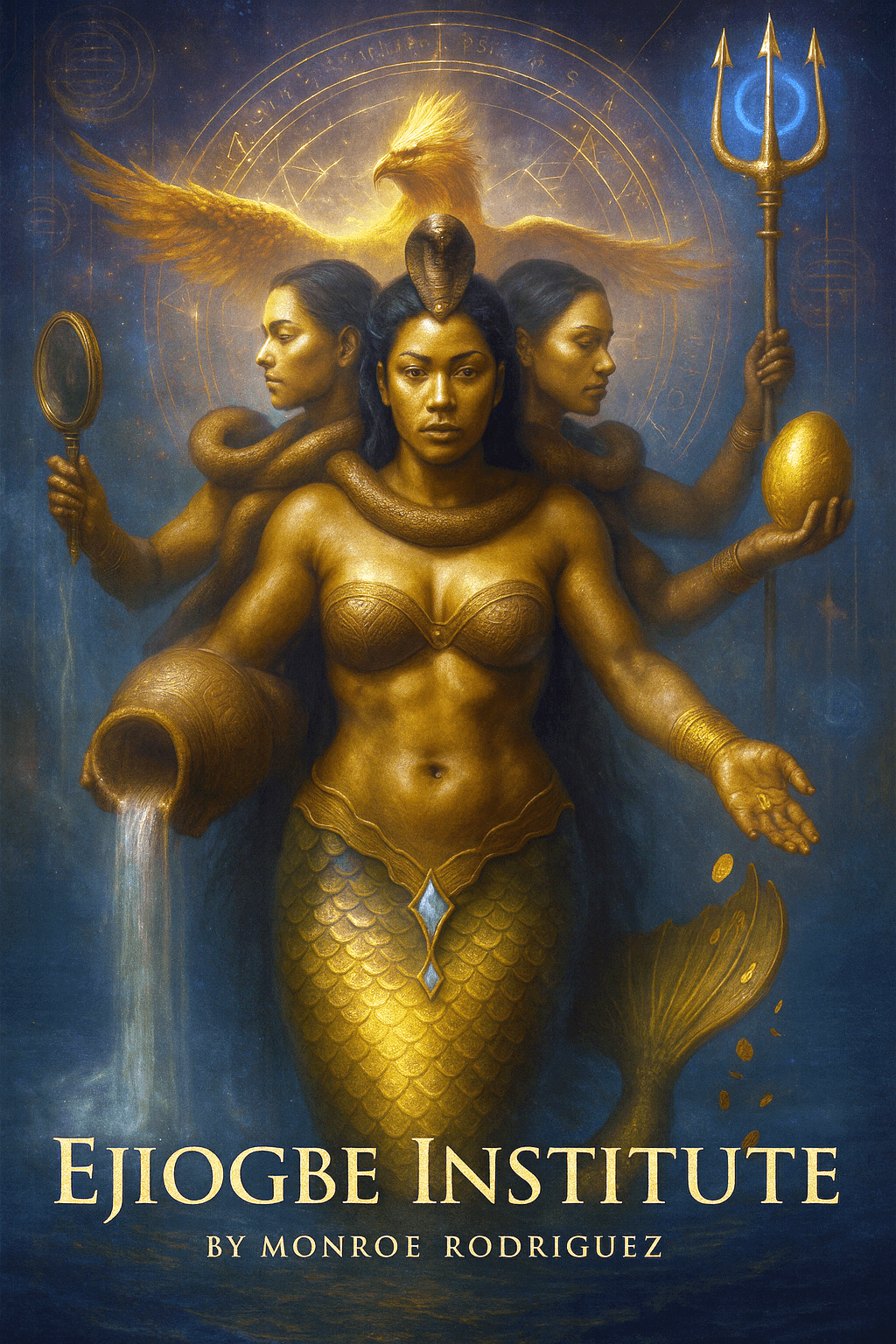
Picture this: a magnificent serpent woman whose lower body undulates with the power of rushing rivers, while her upper form radiates the beauty and wisdom of ancient queens. Her scales shimmer with every color the water can reflect, deep blues of ocean depths, silver of moonlight on streams, and the golden glow of sunset rippling across lakes.
But here's where it gets really interesting. Mami Lissa isn't just about pretty water imagery. She's the force that ensures fertility, prosperity, and the continuation of life itself. When the rains come, that's her blessing. When the crops grow, that's her nurturing touch. When women conceive and bring forth new life, that's her power flowing through the world.
Her worship traditionally involves river ceremonies, offerings of perfumes, mirrors, and jewelry cast into sacred waters. Devotees approach her springs at dawn, when the veil between worlds is thinnest, seeking her guidance for matters of love, fertility, and abundance.
Segbo Lissa: The Celestial Creator
Now let's lift our eyes to the heavens and meet Segbo Lissa. This isn't your typical sky god sitting on a cloud: we're talking about a cosmic serpent whose body forms the very structure of the universe. Imagine a massive serpent stretching across the dome of the sky, its scales twinkling like stars, its movement creating the cycles of day and night.
Segbo Lissa represents the masculine principle of creation: not the nurturing kind that Mami Lissa provides, but the initial spark, the divine blueprint that sets everything in motion. He's the one who established the cosmic order, who decided how the sun would move across the sky, how the seasons would turn, how time itself would flow.

In traditional iconography, you'll see him depicted as a massive serpent coiled around the world, his head touching his tail in the eternal symbol of cosmic cycles. His colors are the gold of the sun, the deep purple of twilight, and the pure white of divine light. He's majestic, powerful, and utterly essential to the functioning of reality itself.
His worship involves offerings made at high places: mountaintops, tall trees, or specially constructed platforms that bring devotees closer to his celestial realm. Ceremonies often take place at noon when the sun is highest, or during eclipses when his cosmic dance is most visible.
The Origin Stories: How Divine Serpents Shaped Reality
Here's where the mythology gets absolutely fascinating. According to traditional Dahomean oral histories, these two weren't always separate entities. In the beginning, there was only the cosmic egg, floating in primordial waters. When this egg cracked open, it released both the celestial and terrestrial forces that would shape reality.
Segbo Lissa emerged first, stretching himself across the void to create the framework of the sky. His movement established the cardinal directions, the path of the sun, and the cosmic order that would govern all existence. But a framework without life is just an empty shell, right?
That's where Mami Lissa comes in. As Segbo Lissa held the sky in place, she flowed forth to fill the spaces he created. Where his celestial fire touched the earth, she provided the waters that would make life possible. Where his cosmic order established structure, she brought the flowing, changing, nurturing force that would allow that structure to support actual living beings.

The beautiful thing about these origin stories is how they show these two forces as absolutely dependent on each other. Segbo Lissa without Mami Lissa would be sterile perfection: all structure, no life. Mami Lissa without Segbo Lissa would be chaos: all flowing energy with no direction or purpose.
Visual Forms and Sacred Symbols
Want to recognize these deities when you encounter them in art or dreams? Their visual forms are absolutely distinctive and loaded with symbolic meaning.
Mami Lissa appears as an elegant serpent-woman, often with her lower body forming graceful coils that seem to flow like water itself. Her human torso is adorned with jewelry that catches light like droplets of water, and her hair flows like riverweed. She might hold mirrors (representing the reflective surface of water), shells (gifts from the depths), or water vessels (her dominion over all flowing things).
Her sacred colors are aqua, pearl white, and silver: all the shades of moving water under different lights. You might also see deep blues and greens, representing the mysterious depths where her power originates.
Segbo Lissa, in contrast, appears as a magnificent celestial serpent whose body stretches across the sky. Sometimes he's shown with multiple heads (representing his dominion over multiple cosmic functions), and his scales often incorporate star patterns or solar symbols. He might be depicted coiled around the world tree or forming the circular boundary of the universe itself.
His colors are gold (the sun), purple (twilight and dawn), and pure white (divine light). These aren't just pretty color choices: they represent his actual functions in maintaining cosmic order.
Domains of Influence: Water vs Sky, Earth vs Heaven
Let's get really practical about what these deities actually do. Understanding their separate domains can help you know which one to approach for specific needs or situations.
Mami Lissa's domain encompasses:
- All flowing waters (rivers, streams, springs, rain)
- Fertility and reproduction
- Abundance and material prosperity
- Healing and purification
- Emotional flow and intuitive wisdom
- The cycles of the moon and tides
- Agriculture and the nurturing of crops
- Protection during childbirth
Segbo Lissa's domain includes:
- The celestial order and cosmic structure
- Time and seasonal cycles
- Divine law and cosmic justice
- Creative inspiration and new beginnings
- Solar energy and masculine power
- Leadership and authority
- The establishment of sacred boundaries
- Weather patterns and atmospheric phenomena

Notice how these domains complement rather than compete with each other? Mami Lissa provides the nurturing flow that allows Segbo Lissa's cosmic order to support life. Segbo Lissa provides the structure and direction that prevents Mami Lissa's flowing energy from becoming destructive chaos.
Worship Practices and Ritual Approaches
Here's where things get really interesting for practitioners. The way you approach these deities reflects their different natures and domains.
For Mami Lissa, traditional worship involves:
- River ceremonies at dawn or dusk
- Offerings of perfumes, jewelry, and mirrors cast into sacred waters
- Libations of sweet water, honey, or champagne
- Dancing that mimics the flow of water
- Meditation beside streams or springs
- Healing baths with herbs sacred to water spirits
- Moon-phase ceremonies that honor cyclical time
For Segbo Lissa, worship traditionally includes:
- Ceremonies on mountaintops or elevated spaces
- Solar timing (dawn, noon, or sunset rituals)
- Offerings of gold, incense, and white candles
- Geometric patterns drawn in sand or chalk
- Drumming rhythms that match cosmic cycles
- Star-gazing and astronomical observations
- Fire ceremonies that honor celestial energy
Complementary Rituals: When Two Becomes One
But here's the really powerful part: there are times when working with both deities together creates something far more potent than approaching either one alone. These complementary rituals acknowledge the fundamental truth that creation requires both structure and flow, both masculine and feminine principles working in harmony.
Traditional ceremonies might involve:
- Setting up altars with both celestial (high) and terrestrial (low) elements
- Timing rituals for dawn (when sky meets earth) or dusk (when they separate)
- Using both flowing water and stable fire elements
- Incorporating both lunar and solar symbols
- Dancing that moves from grounded, flowing movements to reaching, expansive gestures
- Offerings that honor both domains: water vessels filled with starlight-charged water, or mirrors positioned to reflect both water and sky

These joint ceremonies are particularly powerful for major life transitions, community blessings, or when seeking guidance about balancing opposing forces in your own life.
Avoiding Modern Confusion: Staying Rooted in Dahomean Tradition
Here's something crucial that often gets lost in contemporary spiritual discussions: Mami Lissa and Segbo Lissa are specifically Dahomean/Benin deities with particular characteristics, histories, and worship practices. They're not catch-all serpent spirits, and they're not the same as similar-seeming deities from other traditions.
In our globalized world, it's easy to blur the lines between different spiritual systems, but doing so actually diminishes the power and specificity of these ancient traditions. Mami Lissa isn't the same as Mami Wata (though they're related), and Segbo Lissa isn't interchangeable with other sky serpents from different cultures.
If you're drawn to work with these deities, take the time to learn about Benin culture, history, and traditional practices. Read the oral histories. Understand the context in which these spirits emerged and continue to be honored. This isn't about gatekeeping: it's about respect and authenticity.
The Eternal Dance Continues
As we wrap up this deep dive into the realm of Mami Lissa and Segbo Lissa, remember this: these aren't just ancient stories or exotic spiritual concepts. These are living forces that continue to shape reality, available to those who approach them with proper respect and understanding.
The next time you see a river flowing under a starry sky, or watch clouds form over a peaceful lake, you're witnessing the eternal dance of these cosmic partners. Mami Lissa flows, Segbo Lissa provides structure for that flow. Together, they maintain the delicate balance that allows life to flourish in all its beautiful complexity.
Whether you're seeking healing, guidance, or simply a deeper understanding of how spiritual forces shape our world, understanding the distinction and connection between these serpent deities offers profound wisdom. They remind us that creation isn't a solo performance: it's a cosmic collaboration between complementary forces that know how to work together while maintaining their individual sovereignty.
Ready to honor these ancient powers in your own spiritual practice? Start with respect, continue with study, and always remember that you're engaging with forces that have been shaping reality since the cosmic egg first cracked open to release wonder into the world.
